
By Christina A. DiEdoardo, Esq.,
Given the persistence of the uprising and unrest in Baltimore following the death of Mr. Freddie Gray on April 19, 2015 while in the custody of the Baltimore Police Department, which in turn comes on the heels of multiple slayings of African-American men and women by police around the country, it may be time for a rethink on how we treat use-of-force cases. What I propose is–for want of a better title–the #BlackLivesMatter Act of 2015, which would dramatically change the way we treat police who use deadly force.
I. Introduction–Or–“How Did Things Get This Bad?”
In most places, the local police first are expected to investigate themselves and determine if the deaths caused by their officers were “justified” or “unjustified”. In either case, a local official–usually the District Attorney or the equivalent–then gets to decide whether or not to pursue charges against the officer. Usually this decision is made behind closed doors, whether it’s done within the DA’s office or via a grand jury as occurred with the officer who killed Michael Brown in Ferguson, Mo. and with the officer who choked Eric Garner to death in Staten Island, N.Y. In both cases, it is exceedingly rare–if not unheard of–for a DA to determine that a death was “unjustified” and seek criminal sanctions against an officer. (Indeed, in Clark County Nevada, no one can ever recall it happening–I know it hasn’t happened in the ten years I’ve been in practice) It virtually takes an extreme situation like what occurred in South Carolina earlier this month, where an officer was caught on video shooting a man in the back who was leaving the scene–and then apparently placing a taser by his body— for law enforcement to be held accountable.
As a lawyer and as a citizen, I find this state of affairs to be exceedingly dangerous and untenable. It’s true police have a difficult job, but according to the best statistics we have available from the FBI, the number of officers killed by assailants–even accounting for the fetish for firearm ownership by many Americans–is remarkably small, as shown in the chart below.
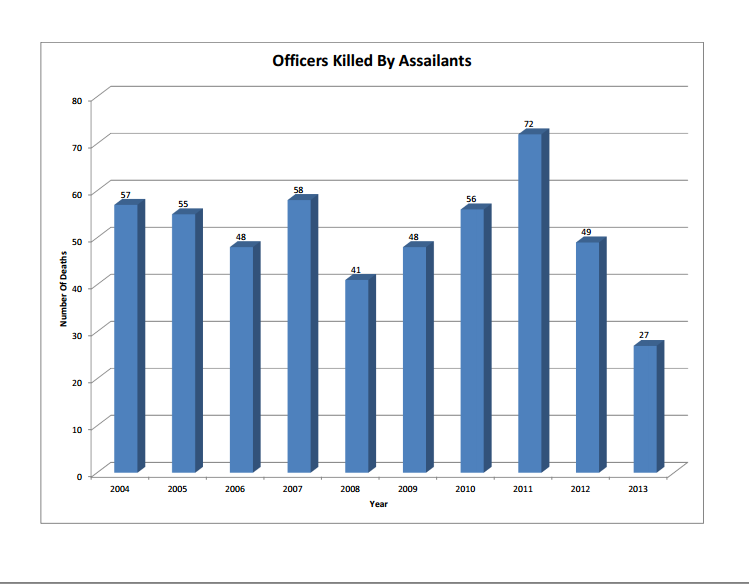
Officers Killed By Assailants 2004-2013
Thus, over a ten-year period, a total of 511 officers were “feloniously” (i.e. murdered, usually by handguns) killed. In contrast, while we lack hard statistics on the number of people killed by the police for a variety of reasons beyond the scope of this post, about 928 people have been killed every year by police , on average, for the last decade.
Parse that for a second. Police have killed (on average) every year for the last decade almost twice the number of total officers lost during the last decade. These are the sort of statistics we would expect to see in counter insurgency operations in Iraq and Afghanistan, not the streets of Baltimore and Ferguson, Mo., and scores of other American cities and towns.
The more police are seen as an occupying army (not difficult to imagine, given their recent predilection for APCs, automatic weapons and the like) the more likely it is they will be considered an occupying army. Sadly, the record of occupying armies in urban settings throughout history, from Warsaw in 1944 to Fallujah from 2004-2007, is not a happy one—ultimately, their presence inevitably feeds a cycle of violence and bloodshed.
On to a proposed road out of this mess, which will be discussed below. My explanatory comments will be in italics where needed.
II. The #BlackLivesMatterActOf2015
AN ACT
To impose greater accountability on law enforcement officers who use deadly force
Section 1. Short title; table of contents.
(b) Table of contents.—The table of contents for this Act is as follows:
Sec. 1. Short title; table of contents.
Sec. 101-Applicability
This Act shall apply to any law enforcement agency that is either (a) part of the federal government or (b) receives support of any kind from any federal source, including but not limited to grants of funds, equipment and training. Any law enforcement agency which applies for or receives support of any kind from any federal source, including but not limited to grants of funds, equipment and training, shall explicitly agree to submit to the jurisdiction of this Act as a condition for receiving or continuing to receive said support.
Comment: Congress has limited power over state officers and cannot “commandeer” them in most cases; however, the Supreme Court has been open to the federal government being able to effectively bribe states to do what it wants. The APCs and other weapons of war being passed to local law enforcement by the federal government come through the 1033 program through the Department of Defense, so if local PDs want to keep their war toys, they’d need to sign up for this if it were enacted.
Sec. 102-Deaths Caused By Police Defined
This Act shall apply in the following situations:
1. When law enforcement officers use deadly force and a death of an individual results;
2. When law enforcement officers detain an individual who dies before being arrested;
3. When law enforcement officers arrest an individual who dies before they are booked at the jail
Comment: The line between “arrest” and “detention” can be a fuzzy one. Since a panoply of constitutional rights come into play upon arrest, officers–not surprisingly–like to claim someone has only been “detained” (despite their being in the transport wagon and handcuffed) and not “arrested” for as long as they can. The Act should cover from when a person is first contacted by law enforcement until they are booked. I realize this does not address the issue of jail violence, but I can’t see a global way to do that and solve the immediate evil of police shooting people in the street at the same time.
Sec. 103-Deaths Caused By Police-Criminal Consequences
1. Each law enforcement agency shall work with the FBI to designate a Sec. 103 officer at the FBI to effectuate the purposes of this section.
2. If a law enforcement officer causes a death in the line of duty, they must surrender their weapon and gun to their commanding officer, who shall notify the Section 103 officer. Upon notification, the Sec. 103 officer shall place the law enforcement officer in federal custody and notify the Office of the United States Attorney for the area of the events which have transpired. The law enforcement officer shall not have bail posted for them or be released on their own recognizance until a public hearing before the United States Magistrate Judge for the area, which shall occur within 72 hours of the notification of the Sec. 103 officer, unless this would require the Court to hear the matter on a day the court is not open, in which case the hearing shall take place on the next scheduled court date.
3. The Office of the United States Attorney shall have thirty (30) days, which may be extended upon leave of court to sixty (60) days to determine whether or not to bring criminal charges against the officer. If the Office of the United States Attorney elects not to charge the officer, they shall issue a detailed statement to the Court and the public as to why they have made this decision. Boilerplate claims such as “witness problems” or “lack of evidence” without an explanation of which witness or witnesses is/are the “problem” and what evidence is “lacking” are insufficient to comply with this requirement.
Comment: This is the heart of the measure as it puts the burden on the United States to investigate and prosecute these incidents, rather than trust to the discretion of a local district attorney that is likely compromised due to their other relationships with the law enforcement entity. It also ensures that the officer will spend some time in jail, rather than being suspended with pay while the local internal affairs department pretends to investigate.
Sec. 104-Civil Actions
In any civil action brought by the survivors of a decedent against the law enforcement officer who killed the decedent or the officer’s law enforcement agency, it shall be presumed that the death is unjustified. The officer and/or the agency may overcome this presumption upon a showing of clear and convincing evidence
Comment: In theory, both sides in a wrongful death case start from zero and have to prove up their arguments. In reality, the police hold most of the cards. This would reverse that by putting the burden on the police to show that the killing was justified, rather than the survivors having to show it was not. In American law, there are three levels of proof–preponderance (50 percent plus one) which is used in most civil cases; clear and convincing (Above 51% but not all the way to beyond a reasonable doubt–often used when one has to prove fraud) and beyond a reasonable doubt, which only applies in criminal cases. This measure gives the officer a chance to justify their actions, but they will have an uphill road to do so.
III. Conclusion
The purpose of a law like this is to change the conversation and the facts on the ground at the same time. At present, there’s little incentive for an officer not to use deadly force since the worst that is likely to happen to them–barring what appear, based on the reporting so far, obvious criminal acts like what happened in South Carolina–is a paid suspension. What this law would do is impose several substantial disincentives to using deadly force in an effort to make an officer think twice. Thanks for reading to the end–and I appreciate your comments in continuing the conversation.
-30-
Copyright Christina A. DiEdoardo, Esq (2015)-May be shared freely as long as it is properly attributed.